

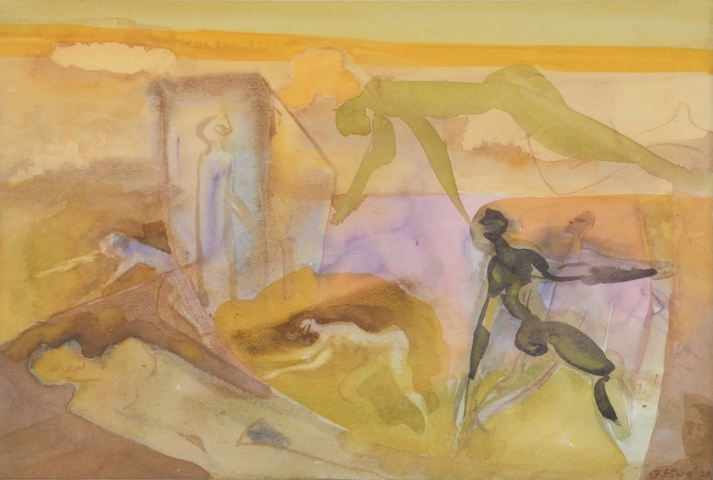
From Rod Watson, Mytholmroyd. 2/9/24.
Dear John
Anita and I went with Stephen Curry to see your ‘Carnivalesque’ exhibition at the Whitworth on the 22nd of last month. Stephen had, of course, seen it previously at the opening but wanted to see it again in more tranquil circumstances.
I, and we, were struck by its strange and vivid beauty. Your exhibition left us with a real ‘aftertaste’ and was still strongly affecting me a long time after I left the gallery. It gave me much cause for reflection, and this letter is a first-off product of that reflection.
Anyone who wants to gain deep access to the foundations of a traditional culture must see this exhibition.‘Carnivalesque’ reminds us that myths and mythic figures are a fundamental, ‘grammatical’ part of human experience. Your exhibition shows us how we not only make sense of our shared lived experience but how we make sense of it at the deepest level. It points to our communal humanity within our lived world. Your achievement is that you have worked from within your culture to afford us access to it. Your portrayal of mythic figures and events takes us to the bedrock, to the core of how we experience our world, and to the deep structures that shape our experience.
In your exhibition, we are reminded through vivid demonstrations that the wisdom and enrichment of myth are not just conveyed by their light but also by their darkness. In myth, in the received wisdom of tradition, there is no light without darkness, and your paintings unerringly express this. I had a somewhat equivalent exposure to that leitmotiv when I attended a carnival in St. Lucia. In carnivals, we are reminded that dysphoria, as well as euphoria, are essential, complementary aspects of the life we hold in joint. The carnival serves to periodically refresh those age-old mythic truths so that we may live them anew “for another first time”, as Harold Garfinkel, the founder of ethnomethodology, nicely put it. Your ‘Carnivalesque’ lets a wide range of people bring these informing myths into their own lived world.
There seems to be a belief amongst some people, even well-meaning ones, that to delve into a particular culture is, somehow, to turn away from other cultures and simply to turn inwards ,into that culture alone, as though a culture were somehow ‘private,’ sealed off, locked away from the eyes of ‘outsiders’. Your exhibition lends the lie to that kind of claim. Whilst, of course, I learned from your work a great deal of inestimable value about the richness of Trinidadian and Tobagan culture , it was also very clear also that you were opening up that culture, not closing it off. In so doing, you show that cultures were ‘designed’ to be made available to others, to be learnt, to be entered into, to be ,in the most profound sense of this term, transparent not only in surface but in depth.
You have made what I metaphorically term ‘the deep grammar’ of human experience accessible to persons standing outside of the specific Caribbean culture you are explicating. We cannot adequately describe its deep grammar in abstract terms , we can only show specific instances of it. Your portrayal of mythical figures gives us a vivid showing of that universal experiential ‘grammar’.
Your intuitive awareness of the universal nature of that grammar is brilliantly exemplified in your finding of some of the characteristics of the ‘Jumbie Bird’ in the Pennine Crow. In doing this, you relate to visitors’ everyday knowledge of their own environment. This reminds me of Ted Hughes’ conception of the crow, as typifying deep-seated and often troubling natural human dispositions . Hughes would have loved ‘Carnivalesque’ and would have intuitively identified with it. What you do, though, is to use these images to build a bridge between cultures and forms of life , to bridge the gap between (many) visitors’ own cultures and another, very distinctive, one which is your own. In so doing, you occasion amongst visitors a process of reflection involving a whole intricate trellis-work of inferences.
I was particularly struck by the multi-modal, multi-sensorial shaping of ‘Carnivalesque’, how the printed word your poems elaborated the visual iconography of your paintings and were, reflexively, elaborated by them. Your poetry furnished a pulse to your work, and to hear you reading it – yes, I donned the headphones! – added yet another dimension, an embodied dimension, to this pulse. You engaged so many of the visitors’ senses. Witnessing this exhibition, your creation of a synthesis felt like being supercharged.
The sheer expanse of the Whitworth really allowed your paintings to breathe. There was no ‘cramping’ in the presentation of your work: we could see your separate works of art as distinct as well as forming part of an ensemble. It was so important that the Whitworth accorded you the space that your expansive work requires.
I spoke a lot with other visitors to the exhibition and with the staff. Everyone deeply appreciated ‘Carnivalesque’ and the marvellous staff, including the young guy at Reception, spoke with enthusiasm about you, Jean and your family. You are a popular man at the Whitworth! It is such a welcoming place.
What a great gallery this Whitworth is. When I was working at the University of Manchester and had a long lunch break, I would often walk down to that impressive gallery, grab a sandwich and sink into their latest exhibition (though I also loved the textiles and textile designs that were a large part of their permanent exhibits). I saw exhibitions by Warhol and many others, but I never saw one as singular and strikingly implicative as ‘Carnivalesque’.
In short, John,
BRAVO!
Your old friend,
Rod.